
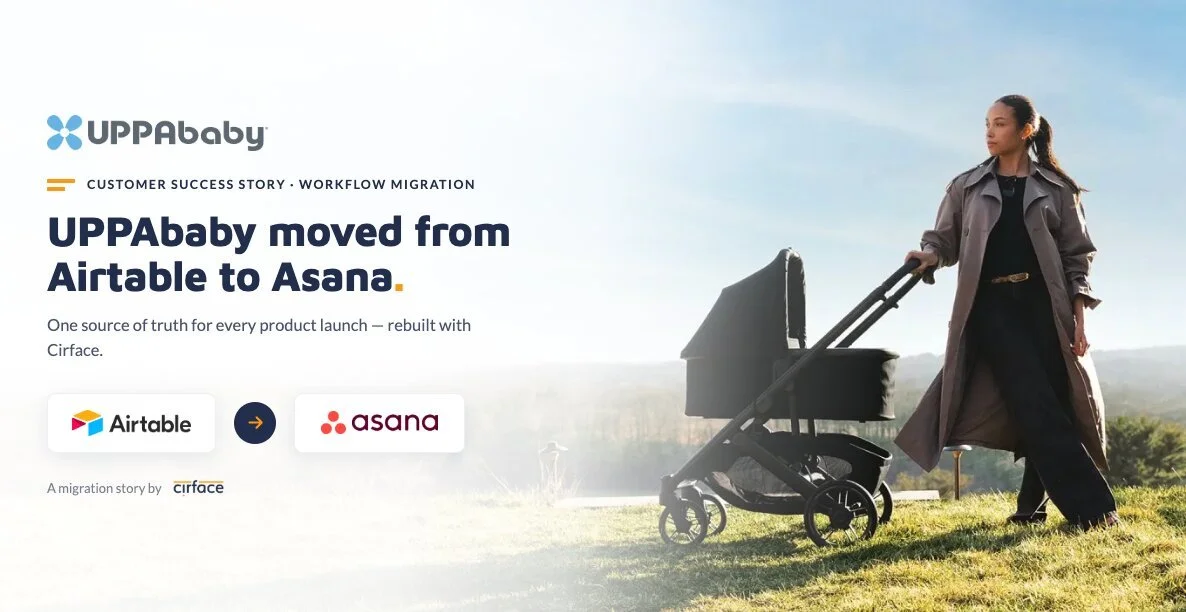
Airtable-to-Asana Migration and Optimization: How UPPAbaby Saved ~12 Hours a Month and Improved Process Consistency

FOCUS
Airtable to Asana migration
SKU-level project structure
Backward-scheduling logic
Role-specific training
SOFTWARE IMPLEMENTED
Asana
TEAMS TRANSFORMED
Product Marketing
Graphics
PROJECT DURATION
Six Weeks
OVERVIEW
With its Airtable contract set to expire and creative production that could not pause, UPPAbaby needed to migrate active artwork into a new platform before a fixed deadline.
Rather than moving the existing setup across as-is, the team worked with Cirface to migrate the work into Asana and redesign the underlying workflow.
UPPAbaby's product marketing and graphics teams manage artwork across a broad portfolio of strollers, car seats, home products, accessories, labels, manuals, and packaging.
As the volume and complexity of that work grew, the team identified an opportunity to strengthen the system supporting it.
UPPAbaby had been using Airtable to track global artwork and product launches, while much of the day-to-day collaboration happened through Microsoft Teams and email.
Large launches with defined timelines were generally well managed, but smaller running changes and loosely scheduled work were harder to track consistently.
AT A GLANCE
The challenge: Migrate active creative work from Airtable before a fixed deadline while improving consistency, visibility, and accountability.
The solution: A customised Asana environment built around SKU-level projects, automated scheduling, structured approvals, and centralised product data.
The results:
100% of active work migrated before the Airtable cutoff
Status reporting decreased from more than four hours to less than one hour per week
The team reported saving an average of three hours per week, around 12 hours a month
Time spent looking for information dropped to between zero and two hours per week
Self-reported process consistency improved from inconsistent to reliable
Team collaboration and accountability both improved from low starting points to consistent, reliable levels
PREPARE CREATIVE OPERATIONS FOR THE NEXT STAGE OF GROWTH
Before the engagement, UPPAbaby had established processes for managing major artwork and product launch initiatives.
The opportunity was to make those processes more consistent across every type of work.
Information such as SKU details, fabric content, UPC codes, copy points, and pack-out requirements did not always enter the workflow at the same stage. This meant team members sometimes had to follow up with contributors as artwork deadlines approached.
Visibility was another priority. Because updates often happened across Airtable, Teams, email, and meetings, managers had to reach out to contributors to understand project progress and team workload.
To measure the engagement, UPPAbaby completed a self-assessment before and after the project, scoring several areas on a one-to-ten scale. Those scores are best read as a maturity check, where the lower ranges reflect ad hoc or inconsistent practices and the higher ranges reflect consistent, reliable ones.
In the pre-engagement assessment, the team rated process consistency, team collaboration, and ownership and accountability in the low ranges, and its Asana proficiency at the starting level.
The goal was to create a system that made work easier to manage without adding unnecessary administration for the team.
“Everybody seems to be on board, and the outside teams are appreciating it a lot more. Things aren’t falling through the cracks because the system alerts us when something is missing.”
— Brenda Preston | Senior Graphic Designer, UPPAbaby
ASANA IMPLEMENTATION
Designing the workflow around the work
Cirface began by working with UPPAbaby to map the complete artwork lifecycle across its product categories.
This discovery process showed that the team needed more than a direct software migration. The new Asana environment needed a consistent structure that reflected how artwork moved from initial information gathering through production, review, and final vendor delivery.
One of the most important design decisions was to organise work at the SKU level.
Instead of grouping several product deliverables together, each accessory or SKU received its own structured project. This gave labels, manuals, packaging, and related artwork a consistent and traceable home.
A smaller accessory, such as a snack tray, could now follow the same clearly defined process as a larger stroller launch.
What changed: Airtable to Asana
The migration was more than a platform swap. Each task that was hard to manage in Airtable mapped to a specific Asana feature that made the work easier to run.
Task or need |
 |
 |
Asana feature |
|---|---|---|---|
| Organising work per product | Several deliverables grouped together, so smaller items like labels and manuals lacked a clear home. | Each SKU or accessory gets its own structured project, so a snack tray follows the same process as a stroller launch. | SKU-level projects from templates |
| Setting deadlines | The team calculated every stage manually from the final vendor upload date. | Key tasks and deadlines generate automatically by working backward from the vendor upload date. | Backward scheduling and dependencies |
| Accounting for lead time | Translation and photography lead time was easy to miss when planning. | Lead-time steps like the two-week translation window build into the timeline automatically. | Dependencies and automated due dates |
| Managing approvals | Tasks were closed and reopened across feedback rounds, so the review history was scattered. | Each review cycle stays connected to the task as a time-stamped record of comments and changes. | Request-changes approval status |
| Collecting intake information | SKU details, UPC codes, copy points, and pack-out requirements entered at different stages, prompting follow-ups. | Standardised intake captures SKU and RSW dates earlier and consistently. | Standardised intake and custom fields |
| Finding product and vendor data | Reference information lived across Airtable, Teams, and email. | More than 300 pre-loaded SKUs and vendors give one shared reference point with consistent naming. | Centralised product and vendor library |
| Tracking progress and workload | Managers reached out to contributors to understand status and workload. | Project status and workload are visible in one place, so updates do not depend on manual check-ins. | Status updates and reporting views |

Building timelines backward from the final deadline
Artwork timelines were often driven by fixed vendor upload dates.
To make those timelines easier to manage, Cirface introduced backward-scheduling logic in Asana. The workflow calculated key tasks and deadlines based on the final vendor upload date rather than relying on the team to calculate every stage manually.
This helped account for work that required additional lead time, including translations, which typically required two weeks, and product photography.
Stakeholders could be alerted earlier, dependencies were easier to see, and the team had a more consistent way to plan each project.
Creating a clearer approval history
Cirface also redesigned the approval process using Asana’s request-changes status.
Previously, tasks could be closed and reopened as artwork moved through several rounds of feedback. The new process kept each review cycle connected to the task, creating a time-stamped record of comments, requested changes, and approvals.
This gave the team a clearer view of where an asset stood and what still needed to happen before final delivery.
Centralizing product and vendor information
To support consistent project setup, Cirface created a centralized library containing more than 300 pre-loaded SKUs and vendors.
The library gave the team a shared reference point for product and vendor information while supporting consistent naming across projects.
Standardised intake also helped the team collect important information, including SKU and RSW dates, earlier in the process.
Testing the system with active work
Before moving every active project into Asana, UPPAbaby tested the new templates and automation using the product launch project.
The trial allowed the team to experience the workflow in a real production setting and identify refinements before the Airtable cutoff.
By the time the deadline rolled around, all active work had been transitioned out of Airtable and into Asana.
Cirface supported the rollout with role-specific training, documentation, and ongoing workflow refinements to help the team build confidence in the new system.
Measurable improvements after implementation
The clearest improvements showed up in the time the team spent on coordination and reporting.
UPPAbaby reported saving an average of three hours per week following the implementation, around 12 hours a month. Time spent preparing and communicating status reports as well as time spent looking for information has decreased significantly, with most project information now centralized in Asana.
In the post-engagement self-assessment, UPPAbaby also reported improvements across every scored area.
Process consistency: inconsistent to reliable
The team reported that Asana alerts were helping surface missed deadlines and prevent work from falling through the cracks.
Team collaboration: developing to reliable
With project information and updates centralized in Asana, team members had greater access to the same information and clearer visibility into the work.
Ownership and accountability: ad hoc to reliable
The team reported stronger ownership of assigned work and clearer accountability across the process.
Asana proficiency: a foundation to build on
The team made substantial progress in its ability to use Asana, moving from a standing start to a working level of proficiency. With the system now in place and the team equipped to use it, adoption is ongoing, and the post-engagement assessment identified a clear runway to keep strengthening habits around logging notes and completing tasks consistently.
A complete migration with a stronger workflow
UPPAbaby completed its Airtable-to-Asana migration on schedule without interrupting active creative production.
The project also gave the team more than a replacement for its previous platform. It created a standardised operating structure for managing creative work across products, SKUs, stakeholders, and deadlines.
By the end of the engagement, UPPAbaby rated its overall satisfaction with the project and described the new system as a significant improvement over its previous Airtable setup.
The team now has a clearer foundation for managing global artwork, improving visibility, and keeping creative work moving.
Planning an Airtable-to-Asana migration?
A successful migration involves more than transferring records between platforms. The structure, timelines, approvals, and responsibilities behind the work also need to move forward.
Cirface helps teams migrate and optimize their workflows in Asana so the new environment supports how their teams actually work.
