
Marketing Automation: 6 Marketing Processes You Should Automate Today
Marketers are strapped for time. If you work in marketing, you know this to be true. Between creating content, managing campaigns and coordinating with sales and design teams, there’s little room for creative thinking. The struggle is real.
Luckily, we live in a time when machines can do all the busy work for us. Workflow automation has made it possible for businesses to automate tedious and repetitive tasks, allowing employees to focus their time on efforts on work that matter.
In fact, HubSpot’s 2024 State of Marketing Report revealed that 20% of marketers are already looking beyond basic tasks and planning to use AI agents to manage their entire marketing automation process.
Marketing automation can help you automate repetitive tasks, such as email marketing, social media campaigns, and targeted ads so you can save time and money. Marketing automation can help you free up your budget to invest in other areas of your business by reducing the need for manual labour.
If you’re new to marketing automation or just automation in general, don’t fret. In this blog post, we’ll be guiding you through the main functions of marketing automation, key tools, and the processes you should start automating. Also, we’ll follow it up with some do’s and don’ts to ensure you make the best out of the tools you’re given.
What is Marketing Automation?
Marketing automation is the use of software and technology to handle the day-to-day marketing tasks that usually require manual effort. A strategic marketing automation process allows businesses to run multi-channel campaigns like email nurturing and social media posting on almost autopilot mode.
Think of some of the tasks you find yourself spending so much time on a daily basis. Setting digital ads, lead nurturing and customer service are some of the activities that many find to be mind-numbing and time-consuming. However, these tasks are paramount to ensuring regular engagement with your audiences. This is why most automation software for marketing focuses primarily on inbound activities. It started with email (made popular by MailChimp), allowing businesses to send out hundreds If not thousands of curated content each day to keep their customers interested. With these tools doing most of the work, marketers were given the space to come up with creative forms of valuable engagement such as newsletters, webinars and ebooks.
Eventually, more software platforms started addressing other functions (social content scheduling, lead scoring, keyword research) and innovating solutions to not only automate repetitive manual processes but also track their effectiveness. While the market has become saturated with modern solutions, some platforms stand out in their effectiveness and ease of use.
Email Automation
Platforms like ActiveCampaign, Mailchimp, Constant Contact, and Brevo (formerly Sendinblue) allow you to send targeted messages based on how customers interact with your site, keeping follow-ups relevant.
Social Media Scheduling
Tools such as Hootsuite, Sprout Social, Agorapulse, and Promo Republic let you plan and publish content weeks in advance across multiple networks from a single dashboard.
All-in-One Marketing Hubs
Comprehensive platforms like HubSpot and Oracle Eloqua connect your entire marketing automation process. These tools sync your CRM data with campaigns to track precisely how a lead becomes a customer.
What are the Benefits of Marketing Automation?
The key advantage of a marketing automation process is the ability to scale your output without increasing your headcount. Removing manual intervention from repetitive tasks reduces the likelihood of human error and helps keep marketing activities consistent and on time.
Beyond the immediate cost savings, a well-built process delivers four key outcomes:
Measurable Marketing ROI: Instead of guessing which ad worked, you get a clear view of your entire funnel. On average, companies earn $5.44 for every $1 spent on marketing automation over the first three years.
More Sales from Existing Traffic: You don't always need more leads; you need better conversion. Companies using automation tools to manage their leads see a 10% or greater increase in revenue within 6 to 9 months.
Significant Productivity Gains: Automation handles the initial research and follow-ups that usually bog down your team. Oracle reports that this shift drives a 14.5% increase in sales productivity and a 12.2% reduction in marketing overhead.
Maximized ROI Through Consolidation: Organizations that perform regular martech audits can identify redundant or underperforming tools, allowing CMOs to safeguard their budgets. With martech accounting for 22% of total marketing spend, optimizing your stack is the fastest way to drive measurable business outcomes.
How does Marketing Automation Work?
Marketing automation platforms are often integrated with CRMs, or Customer Relationship Management systems. This gives them access to customer data, such as contact information and purchase history. With this information, automation platforms can automatically generate and send targeted emails, create personalized landing pages, and run targeted ads.
In simple terms, marketing automation campaigns track the behaviour of your prospects, allowing you to segment your audience and send them the right content in the hopes of converting them to paying customers.
6 Marketing Processes You Should Automate
Now that you have a basic understanding of marketing automation and its function, it’s time for application. Email and social media campaigns are great places to start with automation. Once you’ve gotten the hang of the technology, you can move forward to more complex activities.
1. Email Workflow Automation
The whole marketing automation began with the email. It's only fitting we start with this one. For now, it enables direct, one-on-one communication at a limitless scale. Instead of sending generic blasts, modern automation uses behavioral triggers to send the right message the moment a prospect shows intent that adds personalization.
The image below shows an example of an automated email sequence on HubSpot. With just a few taps, you’re able to send hundreds of emails a day to new website visitors, webinar attendants or newsletter subscribers. You can then use your freed-up time to strategize and come up with valuable content that will aid in the growth of your customer base.
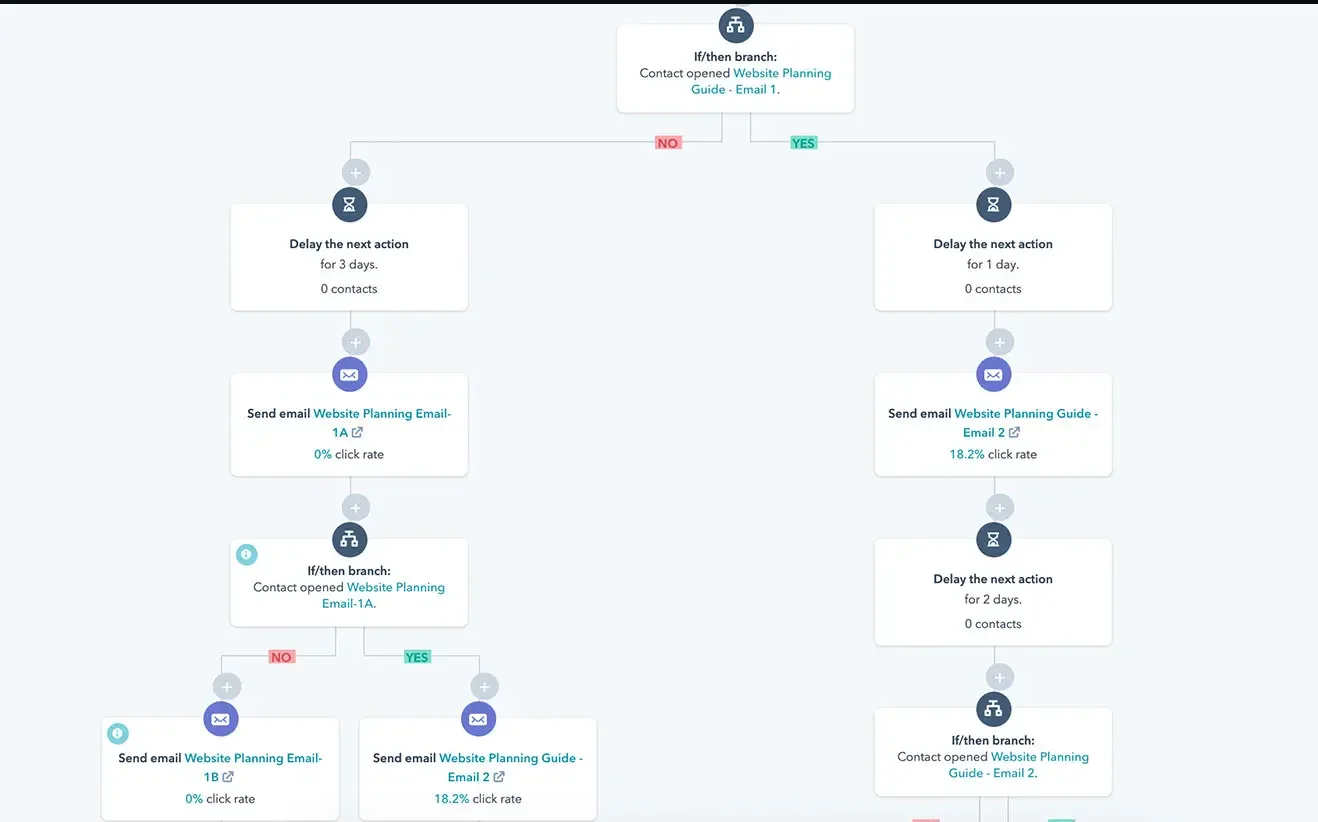
Here are a few examples of automated nurturing strategies via email marketing:
Dynamic Segmentation: Automatically group contacts based on their site activity, industry, or funnel stage.
Behavioral Triggers: Set if/then logic. For example, if a lead watches a webinar but doesn't book a call, the system automatically sends a relevant case study 24 hours later.
Time-Zone Optimization: Use Send Time Optimization (STO) to ensure your message hits the inbox when the prospect is most likely to be active, regardless of their location.
Lead Scoring Integration: Use email engagement (opens/clicks) to automatically update a lead's "warmth" score in your CRM, alerting sales the moment a prospect is ready for a conversation.
Pro Tip: To maximize your marketing automation process, use plain-text or minimalist formatting for high-intent stages, such as demo follow-ups. Litmus found that 63% of customers who converted did so through personalized plain-text emails, as they feel more like a direct, 1-on-1 message from your team than a promotional blast.

2. Social Media Posting Automation
Part of the marketing automation process includes social media. In it, a large part of the process is posting cadence. It’s because manual posting across multiple platforms is a significant human effort, involving researching, writing, designing, and posting content.
Automate social media posting to shift focus from logistics to high-level content conversion strategy in the following ways:
Centralized Distribution: Use tools like Buffer or Hootsuite to push messaging to LinkedIn, X, and Instagram simultaneously. It keeps your brand active without the need for manual cross-posting.
Performance-Driven Optimization: Use built-in analytics to identify which content types (e.g., video vs. text) drive the most engagement. For instance, Sprout Social provides in-depth analytics that let you track which posts drive the most clicks, enabling you to refine your content strategy based on data.
Social Listening Triggers: Advanced tools like Brandwatch can alert your team the moment a high-value prospect mentions your brand, allowing for instant engagement that bridges the gap between marketing and sales.
Global Scheduling: Ensure your content goes live at peak activity times by identifying the best time to post features found in Later or CoSchedule, regardless of your team's time zone.
Pro tip: While distribution should be automated, engagement must remain human. Data from Emplifi shows that 67% of consumers prefer a human response over AI when contacting brands on social media.
3. Paid Ad Automation
Pay-per-click (PPC) management is certainly a data-heavy task in your stack. But you can even automate your campaigns by freeing up resources from pushing buttons to a more strategic approach.
Modern platforms like Google Ads and Meta have evolved from simple bid-adjustment tools into AI systems that optimize for revenue (not just clicks!).
To maximize your ad spend, your marketing automation process should focus on these three aspects:
Smart Bidding 2.0: Instead of manual bids, use AI-driven strategies like Target ROAS (Return on Ad Spend) or Maximize Conversion Value. These systems analyze hundreds of real-time signals, such as location, device, and even weather patterns, to bid higher only when a conversion is statistically likely.
Creative Automation: Choose tools like Google’s Asset Studio or Meta’s Advantage+ to test thousands of ad variations dynamically. According to WordStream, businesses using AI-first campaigns, such as AI Max, achieve higher efficiency by matching the right creative to the right user intent in real time.
First-Party Data Injection: With ongoing cookie deprecation and increased user-privacy controls, the most successful campaigns now feed the AI with clean, first-party CRM data. According to Forbes, high-performing advertisers are using tools such as Google Data Manager to convert third-party signals into first-party tags, resulting in an average 11% increase in marketing signals and significantly lower acquisition costs.
4. Automating Customer Service
You’ve probably experienced this type of automation whenever you visit a product or service website. A small chat box appears in the lower-right corner of your screen, asking if you need any help.
While primarily a service tool, this represents a critical overlap in the marketing automation process: by leveraging your internal knowledge base to answer prospect inquiries in real time, the AI effectively functions as a 24/7 lead-nurturing agent.
Beyond simple greetings, these systems now intercept and log customer inquiries via advanced ticketing integrations with CRMs such as Zendesk or Intercom.
These are the major ways you can elevate your service automation:
AI-Driven Issue Resolution: AI can massively transform your internal team's output. According to Zendesk, 80% of employees report that AI has already improved the quality of their work, while 75% of CX leaders see the technology as a way to amplify human intelligence rather than replace it.
Seamless CRM Logging: When a prospect asks a bot about a specific feature, such as an API or a pricing tier, the system shouldn't just answer and close the chat. It should automatically tag that interest in your CRM via integration. This triggers a personalized follow-up email, turning a simple question into a real sales opportunity.
Automated Sentiment Analysis: Using Large Language Models (LLMs), the system can determine whether the user is frustrated or needs urgent assistance. In fact, HubSpot reports that 60% of customers expect an immediate response (within 10 minutes) when they have a complaint. Automating the detection of that complaint so a human can step in instantly is one way to prevent churn.
Pro Tip: In 2026, the best marketing automation process will not replace people but empower them to drive growth. AI can handle the usual how-to questions and routine FAQs based on the Retrieval-Augmented Generation (RAG) you create, serving as an AI knowledge base. This frees up your team's time to focus on high-value conversations that close deals and build long-term loyalty.
5. Content Automation
In 2026, the marketing automation process has shifted to sophisticated content orchestration — a major shift from mere content generation. AI can churn out words, but search engines are becoming increasingly hostile toward AI Slop. According to Google’s Search Quality Rater Guidelines, content that is auto-generated or paraphrased from other sources with little to no added value is now categorized as lowest quality.
To keep your content from sounding like AI slop, your marketing automation process should leverage these advanced workflows:
Combatting the AI Surge: Research from Graphite indicates that the volume of AI-generated articles published online has overtaken human-written content. However, human-authored content still dominates search visibility, making up 86% of the top results on Google. To remain visible, use automation for outline and data gathering, but ensure that original brand insights and E-E-A-T drive the final output.
Semantic Entity Alignment: Modern automation tools go beyond keyword frequency to identify semantic entities. These are the specific concepts and relationships Google expects to find in authoritative content. Use Natural Language Processing (NLP) tools, such as Inlinks or Surfer SEO, to automatically build a knowledge graph of these entities. Such tools scan top-ranking pages to identify the specific topics and sub-topics Google associates with your primary keyword, allowing you to bridge topical gaps in your draft with a single click.
Multi-Channel Asset Slicing: Tools like Munch or Descript can automatically extract viral-ready clips from long-form video. Such tools often feature AI-powered writing assistants that use style voices to reformat a whitepaper into platform-specific social threads. You can instantly repurpose the core message across multiple formats without manual resizing or rewriting.
6. Automating Communications with Sales Teams
There's a longstanding 'rivalry' between marketing and sales teams, even though both teams share a common goal. This is the result of a lack of transparency and accountability in the process of lead handoffs, which could be easily fixed with clear communications. The fact remains that both teams need each other to hit their organizational targets.
Constant communication between both departments is essential to push leads further down the sales pipeline. Ongoing communication between the two departments is essential to move leads further down the sales pipeline. By integrating a formal marketing automation process, you ensure data flows seamlessly between teams, reducing friction that slows lead progression.
With dozens or even hundreds of leads arriving daily, manual handoffs often lead to missed opportunities. Modern CRM tools solve this by automating MQL notifications and instantly assigning leads to the right reps based on pre-defined territory or expertise rules.
Many CRM tools give you the ability to automate sales communication and notify team members of these MQLs, and even automatically assign them to specific sales reps.
Real-Time Lead Routing: Tools like LeanData or Salesforce Flow to automate the Speed-to-Lead process. These systems use logic-based rules to instantly route an MQL to the most qualified rep based on industry, company size, or geographic territory so that no lead sits cold in an inbox.
Bi-Directional CRM Syncing: Automation platforms like HubSpot or Adobe Marketo allow for closed-loop reporting. When a salesperson updates a lead status to Disqualified, the automation immediately pushes the data back to marketing, triggering a re-nurture campaign rather than letting the prospect drop off the radar
Pro Tip: In 2026, the most effective teams use automated Slack/Teams alerts as a part of automating communication. Instead of forcing teams to check a CRM dashboard, set up a workflow that pings the rep directly in their chat app the moment a high-value MQL interacts with a pricing page or a demo video.
Marketing Automation Do’s and Don’ts
While marketing automation is meant to make your life easier, never forget that you, not the software, are accountable for the success of your campaigns. Below is a list of best practices that will help you make the best out of automation.
Do’s
Take advantage of any features offered by automation tools to send highly personalized messages to your leads. This includes mentioning your customer’s name, profession or location in your emails and paid ads.
Segment your audience based on their age, location, interests and pain points to send tailored messages speaking to their needs.
Make sure to track and monitor the results of your campaigns to ensure your automated processes are working for you not against you.
Always improve your workflows and automated process to increase your conversion rate and the number of qualified leads.
Don’ts
Not everything needs to be automated. Over-automation can result in the lack of human touch that is the foundation of relationship sales.
Don’t forget to disclose any tracking you’re doing with your leads. Always keep them informed of your privacy policy.
Don’t forget to establish clear objectives and strategies before implementing any automation to achieve desired results.
By applying these 6 process automations, you can create a marketing automation strategy that will help you reach your goals. Automating your marketing processes will help you save time and money, and allow you to focus on more important tasks.
Ready to scale your marketing processes? Book a call with us today to help you get started.